

We’ve been fielding the same question for a few years now, popping up in comment after comment on our most popular videos: “Can I actually keep my Social Security benefits if I move overseas?”

The short answer is yes. But the confusion is real, and the myths are everywhere. Some people believe leaving the country automatically cuts off their retirement income. Others think there’s mountains of paperwork or bureaucratic nightmares waiting for them. We’ve even heard folks say they’d lose everything they’ve paid into the system for decades.
None of that is true. But the details matter, and that’s exactly what we’re unpacking today.
The Basic Truth About Social Security and International Living
If you’re an American citizen receiving Social Security retirement or disability benefits, you can continue collecting those payments while living in most countries around the world. The Social Security Administration doesn’t penalize you for choosing to spend your retirement years in Mexico, Portugal, Thailand, or dozens of other destinations that global nomads call home.
This applies whether you’re 62 and just starting to collect early retirement benefits, you’ve hit full retirement age, or you’re receiving Social Security Disability Insurance (SSDI). The rules remain consistent: if you qualified for benefits while living in the United States, those benefits travel with you.
👉 Watch the full episode to see us walk through the Social Security Administration’s screening tool in real time.
The Two Countries Where It Won’t Work

Here’s where reality gets a bit more complicated. There are exactly two countries where the United States will not send Social Security payments: Cuba and North Korea.
We realize this probably doesn’t affect most readers, but we can imagine specific scenarios where it matters. Perhaps you left Cuba after Castro’s rise to power, became a U.S. citizen, built a life here, and now want to return to the country where you were born. We get it. Family ties run deep, and the desire to spend your final years in familiar places is powerful.
But if you move back to Cuba, your Social Security payments will stop. The Social Security Administration will hold those funds, and you can collect all the back payments once you return to the U.S. or move to an acceptable country. The money isn’t gone, but you can’t access it while living there.
The same applies to North Korea, though we’re guessing that’s even less common among our community.
Eight More Countries With Special Arrangements
Beyond those two, there are eight additional countries where the Social Security Administration can’t send payments through normal channels: Azerbaijan, Belarus, Kazakhstan, Kyrgyzstan, Moldova, Tajikistan, Turkmenistan, and Uzbekistan.
Notice a pattern? These are all former Soviet republics with complicated banking relationships with the United States.
The good news is that “can’t send payments through normal channels” doesn’t mean “can’t send payments at all.” It means you’ll need to contact the Social Security Administration directly and work out special arrangements on a case-by-case basis. We don’t know exactly what those arrangements look like because they vary depending on your specific situation, but the option exists.
So out of every country on the planet, only ten present any complications at all. That’s pretty manageable.
How You’ll Actually Get Your Money
Understanding the rules is one thing. Figuring out the practical logistics of accessing your monthly payment in another country is another.
We’ve seen global nomads use two main approaches, and both work perfectly well.
Keep Your U.S. Bank Account

Many people maintain their existing U.S. bank account and use an ATM card to withdraw cash overseas. This is simpler than it sounds. Walk up to an ATM in Mexico City, Bangkok, or Lisbon, insert your card, and pull out local currency.
Your Social Security payment still gets deposited in U.S. dollars. When you withdraw funds, the bank handles the exchange rate automatically. If you’re receiving $1,500 per month and you’re in Mexico, you’ll pull out roughly 30,000 pesos based on current exchange rates. In Thailand, that same amount becomes about 50,000 baht.
One thing to watch: ATM fees add up fast when you’re relying on this method for regular access to cash. International ATM withdrawals often trigger fees from both the foreign bank and your U.S. bank. Over the course of a year, those $3 and $5 charges become real money.
The solution? Look for U.S. banks that reimburse international ATM fees. Charles Schwab is one name that comes up frequently in global nomad circles, though we’re not specifically endorsing them. Just do your homework and find a bank that won’t nickel-and-dime you every time you need cash.
Open a Local Bank Account
The other option is opening a bank account in your new country and having Social Security deposit your payment directly there. The United States has international direct deposit agreements with most countries, so this process is more straightforward than you might expect.
How you open a foreign bank account varies wildly depending on where you land. Some countries make it incredibly easy. Others require residency permits, proof of address, or multiple in-person visits. We can’t give you a universal answer because every country handles banking differently.
But once you’ve got that account set up, the Social Security Administration can send your monthly payment straight there. No ATM fees, no exchange rate surprises, no maintaining ties to a U.S. bank if you’d prefer a clean break.
The Questionnaire Nobody Tells You About
Here’s something that catches people off guard: the Social Security Administration will send you a questionnaire every year or two after you move abroad.
This isn’t an audit or an interrogation. They’re simply confirming that your situation hasn’t changed in ways that affect your eligibility. Did you get married or divorced? Did you start working overseas? Did you move to a different country? Have you, unfortunately, passed away, and is someone else trying to collect your benefits?
These are basic check-ins to make sure the information they have on file still matches reality. Answer honestly, return it promptly, and your payments continue without interruption. Ignore it, and you’re creating unnecessary problems for yourself.
What About Social Security Disability?
If you’re currently receiving Social Security Disability Insurance, the same rules apply. You can collect those payments while living overseas, and the Social Security Administration will continue depositing funds as long as you remain disabled according to their criteria.
Just like in the United States, if your medical condition improves to the point where you’re no longer considered disabled, your payments may stop. But that’s true whether you’re living in Des Moines or Medellín.
The one thing we want to emphasize: everything we’re discussing assumes you already qualify for these benefits. Moving overseas doesn’t magically make you eligible for Social Security if you weren’t eligible before. Get that sorted first, then worry about where you’ll spend your retirement.
Supplemental Security Income Is Different
Here’s where things get tricky for some people: Supplemental Security Income (SSI) does not follow you overseas.
SSI is different from Social Security retirement and disability. It’s designed for people with extremely limited income and resources, and the program operates under different rules. The Social Security Administration will not continue SSI payments if you move outside the United States, and those benefits will stop within about 30 days of your departure.
The reasoning makes sense when you understand the program’s intent. SSI is meant to be temporary support while you work toward financial stability, typically through employment. Since most countries restrict or prohibit foreigners from working, the program doesn’t extend internationally.
If SSI is your primary income source, moving abroad probably isn’t viable under current rules. But if you’re receiving regular Social Security retirement or disability benefits, you’re in much better shape.
Non-Citizens Can Collect Too
We’d be remiss if we didn’t address this: you don’t have to be a U.S. citizen to collect Social Security while living overseas.
The rules get more nuanced depending on your citizenship, how long you lived and worked in the United States, and how you originally qualified for benefits. We can’t cover every possible scenario because there are simply too many variables.
But non-citizens absolutely can and do collect Social Security retirement benefits. We’ve known people who worked in the U.S. for years, earned their 40 credits, qualified for benefits, and then returned to their home countries to retire. The checks kept coming.
If this describes your situation, your best move is contacting the Social Security Administration directly to walk through your specific circumstances. They deal with these cases constantly and can give you accurate guidance based on your exact details.
How to Check Your Specific Situation
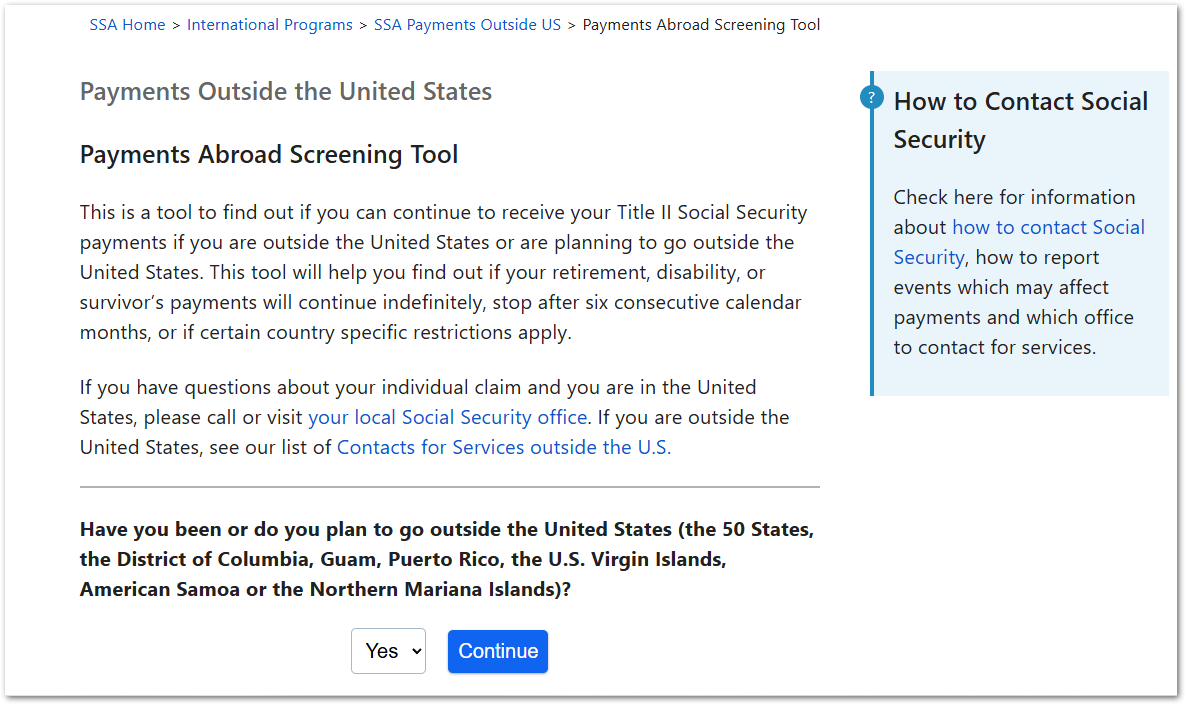
The Social Security Administration offers a simple online screening tool that answers the question definitively: can you collect benefits in the country where you want to live?
It takes about two minutes to complete. You’ll answer four or five basic questions about your citizenship status, what type of benefits you receive, and which country you’re considering. The tool then tells you exactly whether your payments will continue.
We walked through this tool step-by-step in the video version of this article, showing you exactly what to expect. Whether you’re a U.S. citizen planning to retire in Mexico or a non-citizen returning to the Philippines, the tool gives you a clear yes or no answer with no ambiguity.
Check your eligibility using the Social Security Administration’s payment abroad screening tool
The Bottom Line for Global Nomads
For the overwhelming majority of Americans receiving Social Security retirement or disability benefits, moving overseas doesn’t interrupt your income. The myths about losing everything or facing bureaucratic nightmares just don’t hold up against reality.
Ten countries out of nearly 200 present any complications at all. Two prohibit payments entirely. Eight require special arrangements but don’t make it impossible. Everywhere else works smoothly with either direct deposit to a foreign bank or ATM withdrawals from your U.S. account.
We’ve watched people agonize over this decision, convinced they’d have to choose between their dream of living abroad and their financial security. That’s a false choice. You’ve paid into Social Security your entire working life. Those benefits are yours whether you spend retirement in Phoenix or Puerto Vallarta.
The real question isn’t whether you can collect Social Security abroad. It’s whether the life you’ll build overseas is worth making the move. And that’s a question only you can answer.
Links Mentioned in This Article
Social Security Administration Payment Abroad Screening Tool
Check whether you can receive Social Security benefits in your intended country of residence
https://www.ssa.gov/international/payments_outsideUS.html
Social Security Administration International Programs
Complete information about receiving benefits outside the United States
https://www.ssa.gov/international/