

Most retirement conversations start with the same question: How much do I need?
It’s the wrong question.
The better question is:
How far does what I already have actually go?
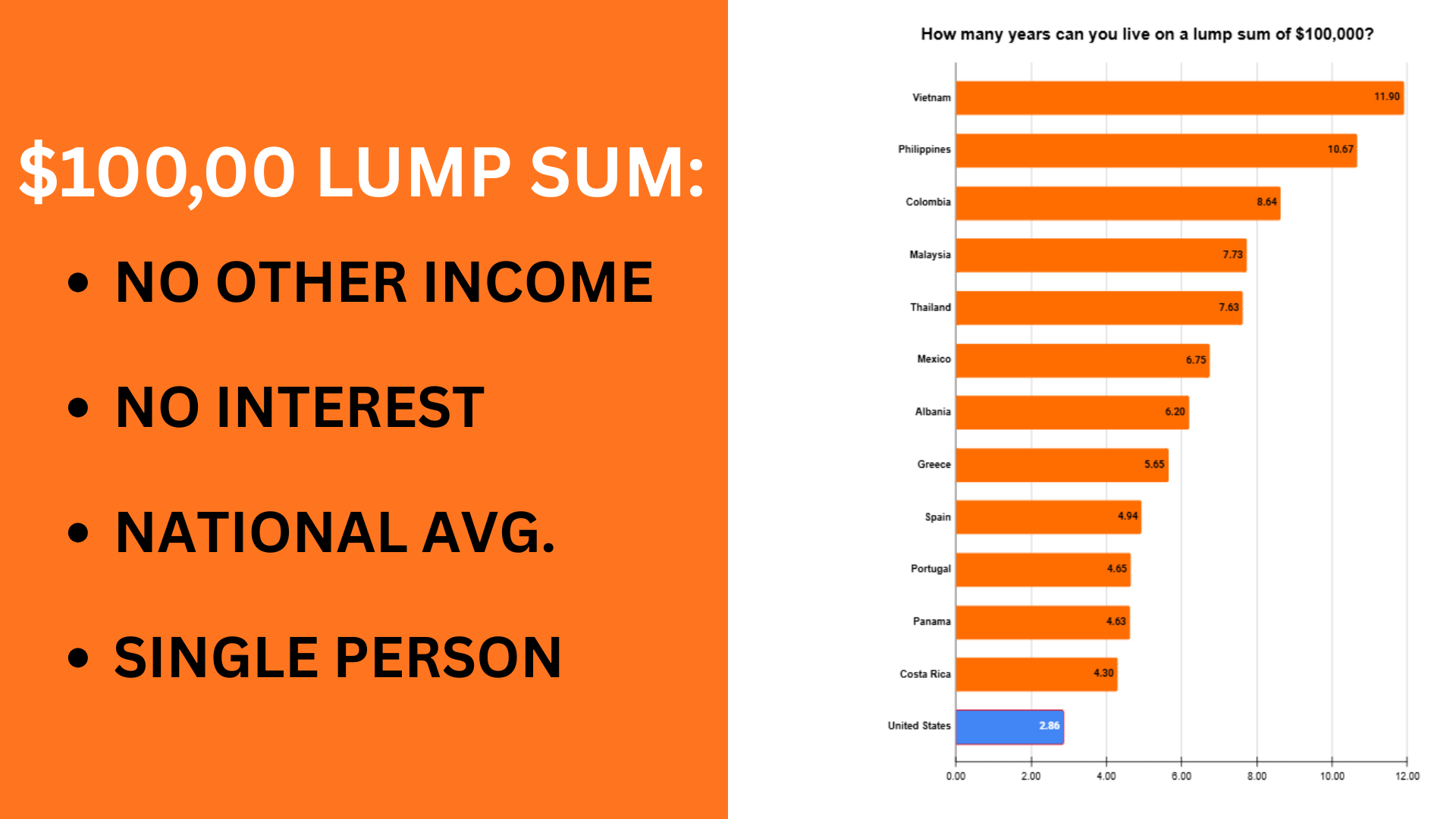
Because depending on where you choose to live, the answer changes everything. We’re talking about the difference between $100,000 lasting less than three years, or nearly twelve.
That gap is not a typo. It’s the difference between running out of money and buying yourself a full decade of freedom.
We’ve been tracking this for a while now. Part of our research as global nomads planning our own exit involves stress-testing destinations against real numbers, not brochure math. What we found when we mapped $100,000 against cost-of-living data across 13 countries wasn’t just interesting, it reframes the entire conversation about what “enough” actually means.
👉 Watch the full breakdown on YouTube: [link to video]
The US Baseline Tells the Whole Story
Here’s the number that anchors everything: in the United States, $100,000 lasts approximately 2.86 years.
That figure comes from Numbeo’s 2025 data. Average cost of living for a single person nationally runs about $2,918 a month when you factor in housing, food, transportation, and utilities. For couples, it’s higher. For anyone living in a major metro, significantly higher.
That’s not a crisis number. But it’s a reality check. It means that for a lot of Gen X households sitting on a solid but not massive savings balance, the domestic math simply doesn’t pencil out for early retirement.
What changes the equation isn’t earning more. It’s relocating the math entirely.
Why $100,000?
A quick word on the number itself before we go further.
We didn’t pick $100,000 because it’s the magic retirement target. We picked it because it’s a clean, round figure that represents someone who has been responsible with money but isn’t sitting on a fortune. Not broke, not wealthy. Just a person with a meaningful chunk of savings trying to figure out how far it actually goes.
A few things this analysis assumes, and you should know upfront.
This is a flat lump sum with no additional income. We’re not factoring in interest earned on the balance, investment returns, or any ongoing income. That’s a simplification, and a deliberate one, it keeps the comparison clean across all 13 countries.
It’s also based on one person. Add a partner and the monthly costs go up, though not always proportionally, rent on a one-bedroom doesn’t double just because two people are sleeping in it.
The most practical way to use this isn’t to match your exact situation to the math. It’s to use it as a planning lens. Say you’re in your late 50s and you know you’ll start drawing Social Security at 62. You don’t need $100,000 to last forever. You just need it to last four or five years, comfortably, while you wait for that income to kick in. In that case, Albania starts looking a lot more interesting than Panama. Portugal moves from “maybe someday” to “this is actually doable right now.”
Use this as a starting point to get your brain moving. The destination decision is more complex than any single number. But this one gives you a frame.
What the Data Actually Shows
Across the 13 countries we mapped, the range runs from 2.86 years (US) to 11.90 years (Vietnam). But the more useful insight isn’t the top and bottom of the list. It’s what happens in the middle.
Countries like Costa Rica (4.30 years), Panama (4.63 years), and Portugal (4.65 years) are popular for a reason: they’re close enough to familiar that the transition doesn’t feel like a leap. Costa Rica has direct flights from most US hubs, English in every expat pocket, and a mandatory healthcare enrollment system for residents that is genuinely solid. Panama runs on US dollars, which eliminates exchange rate anxiety entirely. Portugal gives you EU infrastructure, English in the cities, and a D7 visa that requires only about $1,100/month in passive income to qualify.
None of these are radical choices. They’re the first rung of the ladder.
The more compelling story starts further up the list.
🌏 We have put together a whole list of cost of living snapshots. This will give you good number to use in your research. Follow the link HERE

The Countries Most People Overlook
Albania shows up at 6.20 years and most people have never seriously considered it. They should. A one-bedroom apartment in Tirana runs $600–$700 a month. A couple lives comfortably in the capital for $1,200–$1,500. And US citizens can stay for a full year with nothing more than a passport stamp at the border. No visa application, no consulate visit, no 90-day shuffle.
That one-year visa-free entry is genuinely unusual. Most European countries cap Americans at 90 days within any 180-day Schengen window. Albania is not in Schengen. That distinction matters enormously for someone who wants to test-drive expat life without bureaucratic commitment.
The tradeoffs are real: no direct flights from the US, a meaningful language barrier outside Tirana, and infrastructure that’s still developing. But the country is an EU candidate, the coast is stunning, and the expat community is growing fast. For the person who wants Mediterranean Europe at a fraction of the cost, this is the answer the algorithm isn’t showing you.
Colombia at 8.64 years deserves its own conversation. Medellín in particular has undergone a transformation that most Americans haven’t caught up to yet. The city consistently ranks among the top expat destinations in South America, with world-class private healthcare, a spring-like climate year-round, and a pensionado visa that requires only about $1,350/month in passive income with no age requirement. The crime perception from the 1990s still lingers in American minds. The reality on the ground in major expat neighborhoods is dramatically different. Common sense still applies, as it does everywhere. But the safety narrative is decades out of date.
The Asia Numbers Are Genuinely Striking
If you’re open to Southeast Asia, the math shifts in ways that are hard to process at first.
Thailand hits 7.63 years. Malaysia hits 7.73. Philippines hits 10.67. Vietnam hits 11.90.
For Thailand and Malaysia, the lifestyle is legitimately comfortable, not budget-travel comfortable, but genuinely good. Chiang Mai or beach towns in Thailand run $1,200–$1,500 a month for a couple. Parts of Malaysia like Penang come in around $1,100. Private healthcare in both countries is excellent and costs a fraction of what you’d pay in the US.
The Philippines sits at nearly 11 years largely because the provincial cost of living pulls the average down significantly. The bigger expat hubs like Cebu still run $1,200–$1,500/month. The standout advantage for Americans is language: English is widely spoken across the country, making this the easiest linguistic transition of any Asian destination on this list.
Vietnam at nearly 12 years is in a category of its own. One-bedroom apartments in non-tourist cities run $300–$350 a month. Total monthly living for a couple can come in under $800 if you’re living locally rather than in an expat bubble. The COL is roughly 60–70% lower than the US.
The tradeoff with Vietnam is the visa situation, which is the most important thing to understand before you get excited about that number. There is no retirement visa. Most long-term residents use a 90-day e-visa renewed through periodic border runs, which is legal and common but not as secure as a formal residency pathway. Long-term options exist through investor or business visas, but they require investment and more complexity. Vietnam is the highest upside and the highest logistical commitment on this list. It rewards the adventurous and the prepared.
The Number Isn’t the Decision
Here’s what the data can’t tell you: which of these places you’ll actually want to wake up in.
The $100K lens is a starting filter, not a finish line. Fourteen years in a place you hate is worse than six years somewhere that fits. The real variables are harder to quantify: how much does the language barrier matter to you? Do you want EU healthcare infrastructure or are you comfortable with private insurance in Southeast Asia? Are you moving with a partner who has different dealbreakers? Is a path to permanent residency important, or are you comfortable with annual renewals?
These aren’t small questions, and they don’t have universal answers.
That’s exactly why we built our Dream Destination Worksheet, a 15-question diagnostic tool that helps you move past “vacation feels” and identify the Tier 1 dealbreakers that actually drive long-term happiness in a new home. Cost of living is one input. The worksheet makes sure it doesn’t crowd out everything else.
[Link to Dream Destination Worksheet here]
One More Thing Worth Knowing
The income requirements for retirement visas in most of these countries are built for people living on Social Security and pensions. The average US Social Security check in 2025 runs about $1,780 a month. That clears the threshold for Costa Rica, Panama, Portugal, Colombia, and the Philippines without additional income. If you’re also drawing from an IRA or investment account, the list opens up further.
The point: you don’t need to be wealthy to make this work. You need to be strategic about where you land.
That’s the whole argument this video makes, and it’s the argument we make every week as we plan our own exit.
Links Mentioned in This Article
👉 Watch the full episode: [link to video]
📋 Dream Destination Worksheet: [Link to resource here]
🧮 GenXit Bridge Fund Calculator: [Link to resource here]
🌏 Cost of Living Snapshots: [Link to Cost of Living Snapshots here]
Who We Are

Mike and MJ are the voices behind The GenXit Project, a resource for Gen X professionals exploring early retirement, financial independence, and life abroad. We cover international relocation, expat finance, and the real logistics of leaving it all behind (in the best way). Follow our journey on YouTube and the website as we turn “what if” into “what’s next.”