Something shifted in 2025 that most Americans haven’t fully processed yet.
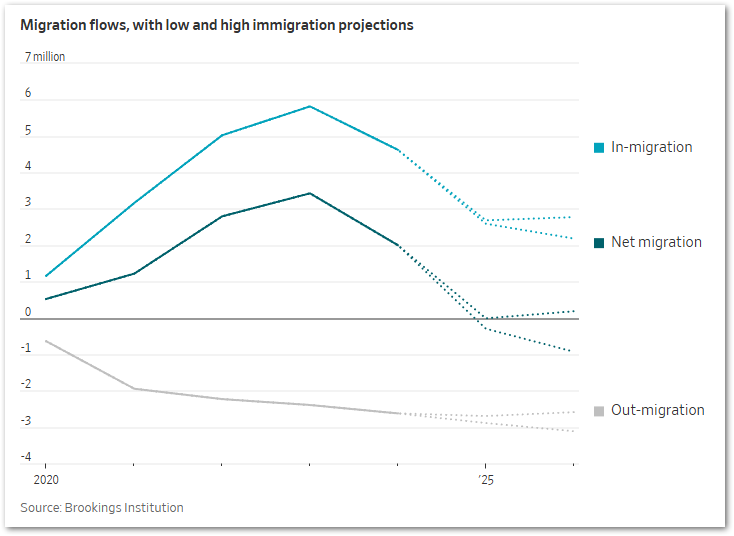
For the first time since the Great Depression, more people left the United States than moved into it. Not people who were forced out. Not people who were deported. American citizens, ordinary people with ordinary lives, who looked at their options and chose somewhere else.

We’ve been living this conversation for years now. And when the Wall Street Journal published a data-backed investigation spanning more than fifty countries, it confirmed what a lot of us have quietly known: the life you actually want may be more available somewhere else than it is at home.

Here’s what the data shows, what it means, and why it matters if you’re seriously thinking about what comes next.
The Number That Stopped Us Cold
The Brookings Institution estimates the U.S. lost a net 150,000 people in 2025. That number will likely grow in 2026.
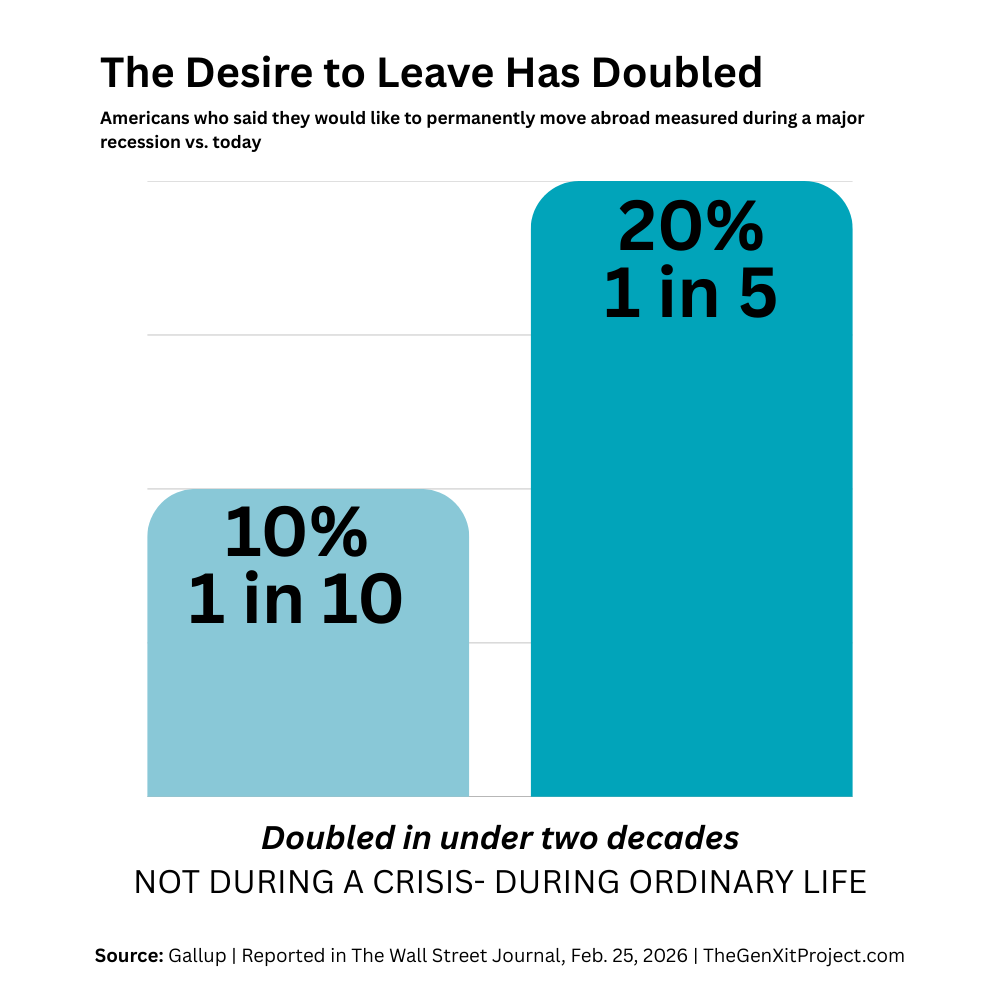
To understand why that’s significant, consider this: when Gallup asked Americans during the 2008 recession how many wanted to permanently leave the country, the answer was one in ten. Last year, during no recession, the answer was one in five. That number doubled in less than two decades.
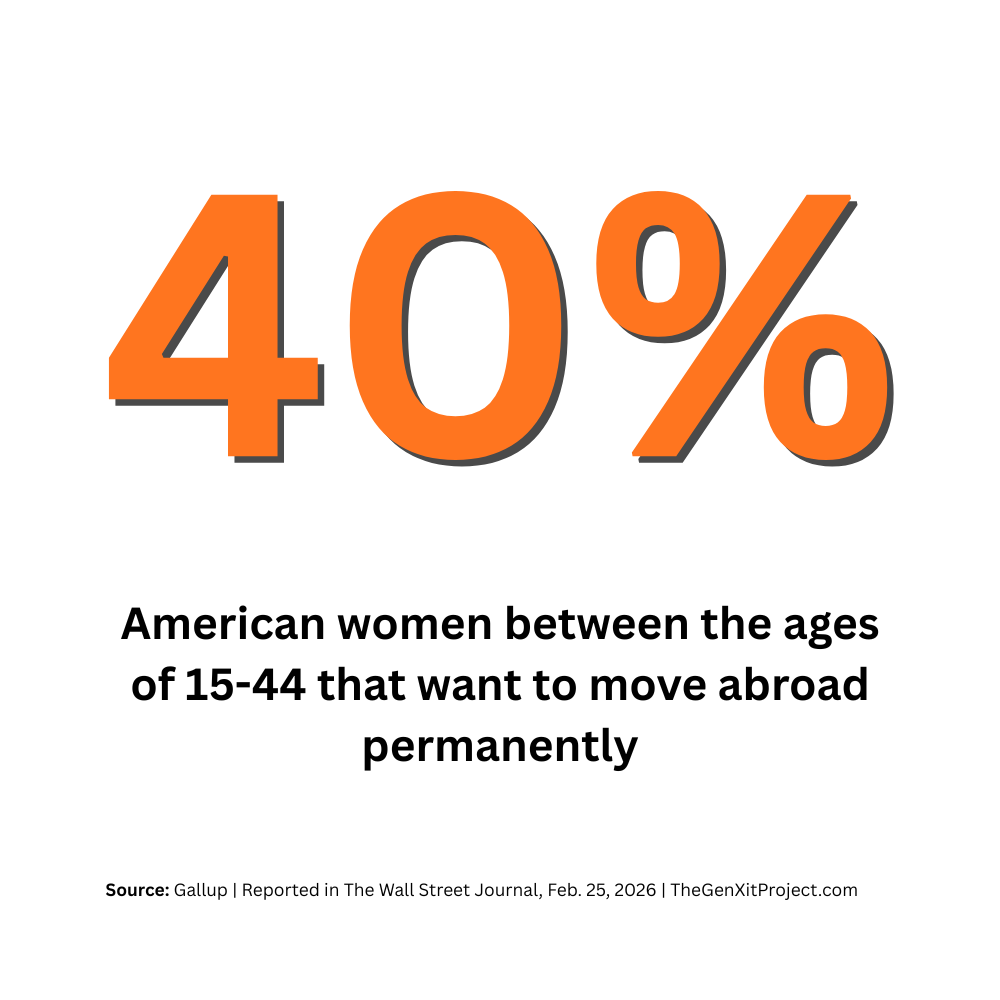
Forty percent of American women between the ages of fifteen and forty-four said they’d like to permanently move overseas if they could. That’s a larger percentage than sub-Saharan Africans who say the same, a region the world typically associates with economic desperation.
These aren’t fringe numbers. This is a measurable, documented shift in how Americans feel about where they live.
👉 Watch the full breakdown on YouTube: [Link to episode]
Who Is Actually Leaving
Here’s the part that surprises most people: it’s not who you’d expect.
For years, the image of the American abroad was young, credentialed, a little adventurous. The laptop-and-Bali crowd. One relocation company founder, herself a 54-year-old Alabama native who moved to Yucatán in 2024, put it plainly: “Previously, the Americans leaving were super-adventurous and well-credentialed. Now they’re ordinary people, like me.”
The WSJ profiled Kelly McCoy, 45, from Buffalo, New York. She was making $80,000 a year as an insurance analyst and struggling to keep up. She moved to Albania in 2024 to take advantage of a special visa that allows Americans to live and work there with no tax on foreign income for a year. She broke her arm shortly after arriving. She went to the local hospital, got treated, and wandered the halls afterward confused, because nobody came to charge her.

She has since helped fifteen Americans on Social Security or disability make the same move. Her assessment: you can live comfortably in Albania on $1,000 a month.
Then there’s Chris Ford, 41, who works remotely for a Dallas real estate investment firm from Berlin, where he coaches a kids’ baseball league. He told the Journal: “The wages are higher in the U.S. but the quality of life is higher in Europe.”
That sentence is the whole conversation.
If You’re Still Figuring Out Where You’d Even Go
That’s exactly where most people get stuck. Not “should I leave” but “where would I even start?”
We built the GenXit Dream Destination Worksheet for this moment. It’s a 15-question diagnostic tool designed to move you past “vacation feels” and help you identify the dealbreakers that actually determine long-term happiness in a new home, things like healthcare quality, visa ease, walkability, and what it really means to move with a partner.
[Link to GenXit Dream Destination Worksheet]

The Geography of the Exit
The WSJ analyzed data from more than fifty countries. The pattern is consistent and undeniable.
In nearly every one of the European Union’s twenty-seven member states, the number of Americans arriving to live and work is at an all-time record.
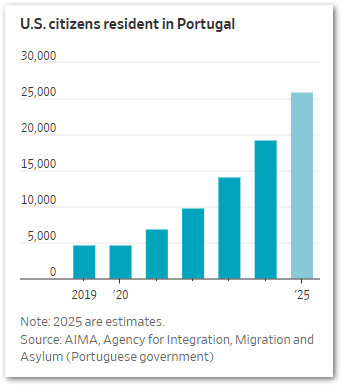
Portugal has seen its American population jump more than 500% since the pandemic, and grow another 36% in 2024 alone. Americans now represent 58% of all foreign home buyers there. House prices in some historical districts have doubled in five years.
Ireland welcomed 10,000 Americans in 2025. Double what came the year before.
Last year, more Americans moved to Germany than Germans moved to America. The flow reversed.
Spain and the Netherlands have nearly doubled their American resident populations in the past decade. There’s a square in Madrid that locals have nicknamed “Plaza U.S.A.”
France is one we’ve been paying close attention to, and MJ just came back from Paris.
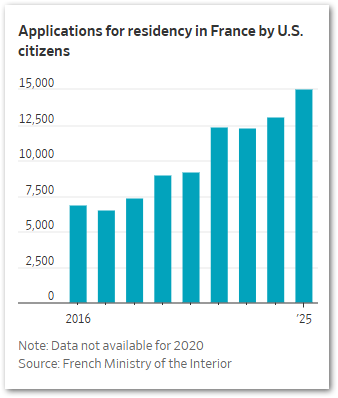
She went over President’s Day weekend, stayed in Le Marais, and spent four days keeping both eyes open. Not as a tourist. As a global nomad asking the question that actually matters: could we afford to live here?
The honest answer? Paris and Chicago landed in roughly the same cost ballpark. A mid-range dinner for two runs about $83 in Paris versus $100 in Chicago. A one-bedroom in the city center comes in around $1,596 a month versus $2,469 in Chicago. Those numbers sound promising until you realize that for geographic arbitrage to work for us, retiring at 57, living off savings before Social Security or retirement accounts kick in, a destination needs to meaningfully stretch our bridge fund dollars. Paris doesn’t do that. It matches what we’re already spending. It doesn’t beat it.
MJ put it simply: “You’re not moving to Paris to save money. You’re moving there for a specific lifestyle.”
She loved it. She’d go back in a heartbeat. But it didn’t make the top five.

On friction, getting an apartment, navigating bureaucracy, the language barrier day in and day out, she put Paris at a seven or eight out of ten. Doable. But not easy. And the walkability is real, with one caveat she wanted to flag for anyone whose knees have opinions: some of the deeper metro stations are a serious stair climb. She got lapped by a couple in their 70s. She’s still not over it.
The full Paris episode is worth watching if France is on your list.
👉 [Watch: Is Paris Worth It for Early Retirement? What MJ Actually Found]
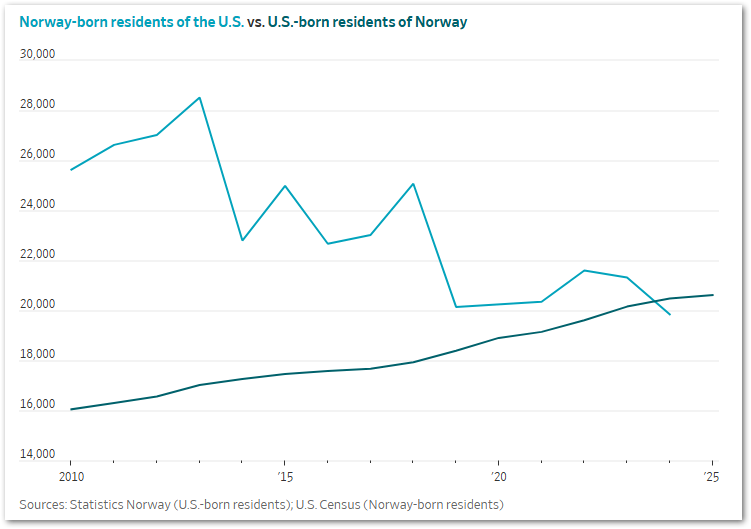
In Norway, a country Trump has mentioned in rallies as a source of desirable immigrants, the number of natural-born Americans living there now exceeds the number of Norwegian-born residents living in the U.S. The direction of that flow reversed too.
The WSJ’s analysis of just fifteen countries identified at least 180,000 Americans who moved to those countries in 2025 alone. The real number is almost certainly much higher.
What’s Actually Driving This
The Journal describes the motivations of people leaving as “a tangle of economic incentives, lifestyle preferences, and disenchantment with the trajectory of America.”
Cost of living is the most obvious thread. Healthcare abroad versus healthcare in the U.S. is not a close comparison in most developed countries. Housing in major American cities has priced out an entire generation. Childcare. Student debt. The general feeling that no matter how hard you work, you’re running in place.
But there’s something underneath the economics.
A father named Chris moved his family to Berlin because he didn’t want his five-year-old doing active shooter drills in kindergarten. A family in Lisbon relocated after their son’s school had its second active shooter scare. A Texan fintech specialist in Madrid discovered that by canceling his American health insurance plan and buying European private coverage instead, he saved enough to afford tuition at one of the capital’s elite schools.
These are not people who ran the numbers on a spreadsheet and made a cold calculation. These are people who hit a threshold and decided something had to change.
If You’re Still Figuring Out the Money Side
The financial piece of international relocation is where most people stall. Not because they can’t do it, but because they don’t know how close they actually are.
The GenXit Bridge Fund Calculator was built to answer that question directly. It helps you visualize the gap between today and your exit date, tracking debt elimination and savings growth so you can pinpoint your actual projected Freedom Date.
[Link to GenXit Bridge Fund Calculator]

The Students, the Retirees, and the Long Game
One signal the WSJ highlights that suggests this isn’t a passing moment: education.
More than 100,000 American students are currently enrolled abroad for more affordable university degrees. The number of Americans obtaining a degree in Europe has doubled since 2011, rising 14% last year in the U.K. alone. Of the twelve American students the Journal spoke to, studying across Spain, Scotland, and England, only one planned to return to the U.S.
When students build networks, careers, and relationships overseas, mobility becomes generational.
Renunciations of U.S. citizenship jumped 48% in 2024. The U.S. government now has a months-long backlog of Americans asking to formally renounce. Americans are applying for British citizenship at the highest rate since records began in 2004. Irish passport applications from Americans hit nearly 40,000 in 2025.
These are not the actions of people who are experimenting. These are the actions of people who have decided.
What This Means for People Like Us
The Journal ends their piece with a genuine question: are these emigrants a credit to American strength, people empowered by American salaries to go live well somewhere else? Or do they represent something else, a loss of faith, a vote against the direction the country is heading?
We think it’s neither one nor the other cleanly. For most people it’s both, tangled together in ways that are hard to separate.
We’re not leaving because we hate where we come from. That part isn’t simple, and anyone who tells you it is isn’t being honest with you. But we’re also clear-eyed about what we see. The cost of healthcare in retirement in the United States is a genuine financial threat. The cost of housing in desirable areas has made a comfortable retirement much harder to achieve than it was for our parents’ generation.
And when you look at what your dollar actually buys in Lisbon, or Valencia, or the Algarve, and compare that to what it buys at home, the conversation changes.
A Temple University researcher named Caitlin Joyce, who has spent years studying this migration trend, said it plainly in her Journal interview: “Americans move abroad and find they like life better abroad.”
At the end of her interview, she asked the reporter, based in Europe, what it was like living over there.
Because she was thinking about moving too.
The Option Has Always Existed. Now It’s Accessible.
What’s changed isn’t that life abroad is possible. It’s that it has become practical for ordinary people, not just the adventurous or the wealthy.
The infrastructure exists. The visa pathways are real. The communities of Americans who have already made the move are large enough that you won’t be starting from zero. And the data now confirms what a lot of us have felt for a while: this is not a fringe idea. This is a direction that millions of people are moving in, for reasons that make complete sense.
The only question is where you are in that conversation.
Links Mentioned in This Article
🎬 Watch the Full Episode on YouTube, [Link]
Who We Are Mike & MJ are the voices behind The GenXit Project, a resource for Gen X professionals exploring early retirement, financial independence, and life abroad. We cover international relocation, expat finance, and the real logistics of leaving it all behind (in the best way). Follow our journey on YouTube and Substack as we turn "what if" into "what's next."