We didn’t start our retirement research thinking about safety.
We started where most people do: cost of living, weather, whether we could afford a decent apartment without draining a savings account we’d spent decades building. Safety felt like a given. Something you checked once and moved on from.
Then we pulled up the 2025 Global Peace Index.
The United States ranks 128th out of 163 countries. That number stopped us cold, not because it was entirely surprising, but because seeing it ranked and measured alongside places we’d always mentally filed under “risky” changed something about how we were framing this whole decision. We weren’t just choosing where we wanted to live. We were choosing how much stability we actually wanted to build our next chapter on.
That shift in framing is what this article is about.
The Question We Started Asking Differently
Most retirement abroad content leads with beaches and low rent. And look, those things matter. We’re not pretending they don’t. But once you’ve sat with the peace index data for a while, you start asking a different question. Not just “can we afford this place” but “what kind of world are we actually moving into?”
The Global Peace Index is published annually by the Institute for Economics and Peace and covers 163 countries across 23 indicators: geopolitical stability, internal conflict levels, militarization, societal safety. It’s not a vibe. It’s a composite measurement, and it gave us a framework for comparing countries that went deeper than cost-of-living spreadsheets.
We built a short list of destinations that scored dramatically higher than the U.S., had real visa pathways for American retirees, and offered a cost of living our retirement income could actually work with. Five countries made that list. Here’s what we found, and what surprised us along the way.
👉 Watch the full episode on YouTube where we break down every country, share our honest personal reactions, and get into the visa details that most retirement content glosses over.
The Country That Made Us Rethink “Affordable”
Costa Rica — GPI Rank: 54th
Costa Rica came up early in our research and kept coming up. It’s ranked 74 spots above the United States on the peace index, and there’s a specific historical detail that we kept returning to: in 1948, Costa Rica abolished its military and wrote that decision into its Constitution. The money went into education and healthcare instead. For a couple thinking seriously about where to plant roots for the next few decades, that kind of institutional signal feels different than a good climate ranking.
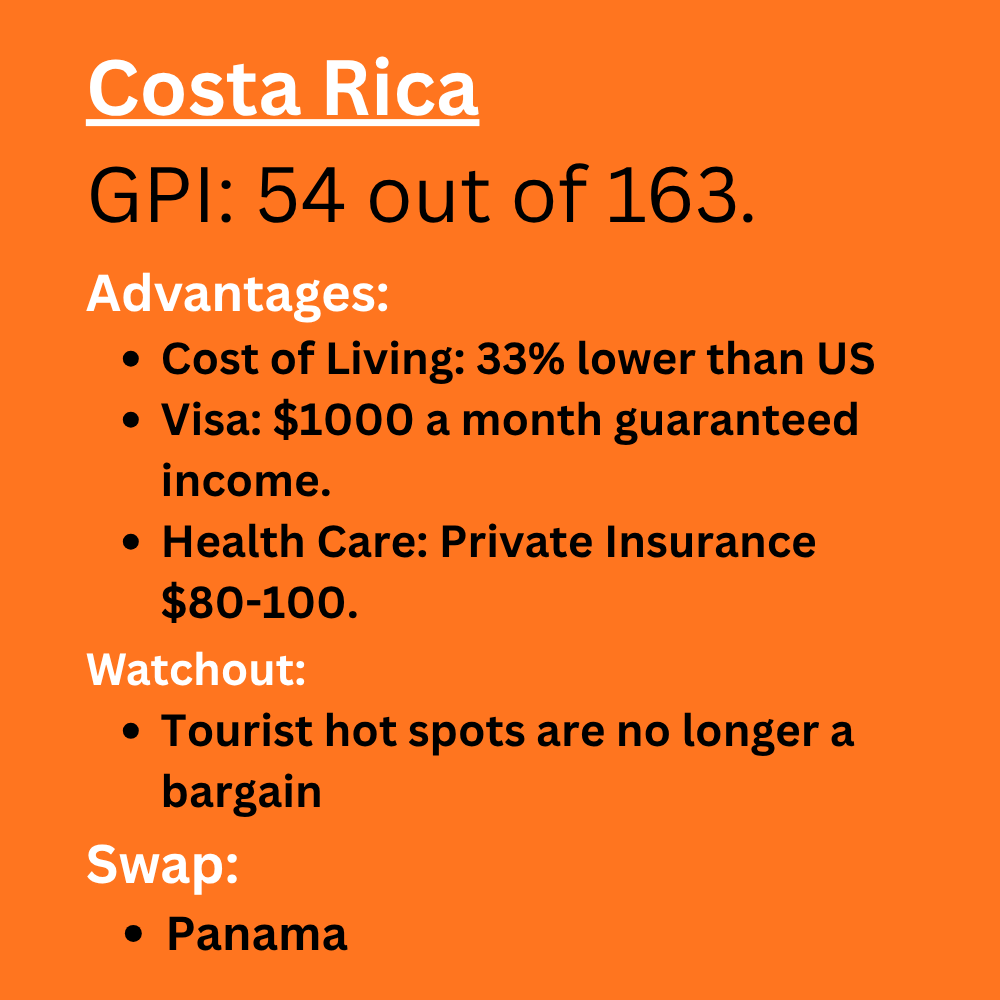
The practical picture is solid. The Pensionado visa requires $1,000 per month in guaranteed lifetime income, Social Security qualifies, and one application covers a spouse and dependents under 25. There’s no minimum age. Overall cost of living runs about 33% lower than the U.S. average with rent running roughly 53% lower.
Where it gets interesting is the gap between Costa Rica as it’s marketed and Costa Rica as it actually exists. The beach corridors, the surf towns, the resort areas in Guanacaste have crept toward U.S. pricing in popular pockets. The interior, the Central Valley, and communities off the tourist track are a genuinely different experience in both cost and character. The 33% figure is a country average. Where you land inside Costa Rica matters as much as the decision to go there.
We’re also keeping an eye on Panama as a parallel option. It ranks 84th on the peace index, still well above the U.S., uses the U.S. dollar, and has one of the most generous Pensionado programs in the region. We have a trip booked and will report back.
The One That Respects You Enough to Be Honest About Cost
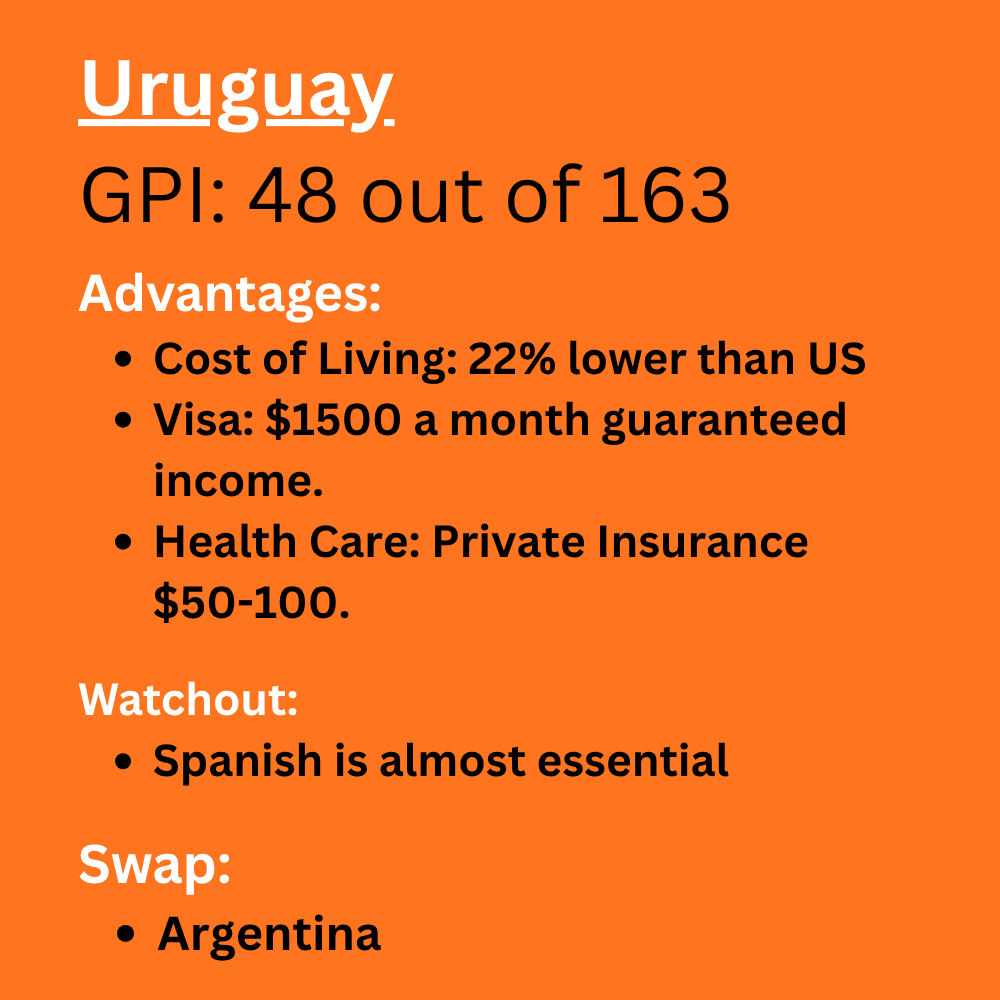
Uruguay — GPI Rank: 48th
Uruguay is 80 spots above the United States on the peace index and has the most stable democratic institutions in South America. It’s also the most expensive country on this list, and we’d rather tell you that upfront than bury it.
The Switzerland of South America comparison gets used a lot, and it holds up in the ways that matter: rule of law, political consistency, a functional public infrastructure. Montevideo regularly ranks among the most livable cities in the hemisphere. None of that comes at Southeast Asia prices, and the relocation content that leaves that part out is doing you a disservice.
Cost of living runs about 22% lower than the U.S. average with rent roughly 62% lower. The Rentista residency program works from stable passive income, and based on what actually gets approved, $1,500 per month appears to be the realistic floor. Social Security, pension, dividends, and rental income from property back home all qualify.
One thing we spent real time on: if the tax residency designation is part of your plan, which comes with meaningful financial benefits, there’s typically a $100,000 investment in Uruguayan real estate or securities plus 60 days of physical presence per year involved in that conversation. Worth knowing before you plan around it.
The honest thing we’d tell a friend considering Uruguay is this: Spanish is not optional outside Montevideo. The capital has an English-speaking professional class. The rest of the country is Spanish, full stop. That’s not a dealbreaker, but it needs to be part of the plan rather than an afterthought.
If the Southern Cone lifestyle appeals but Uruguay’s price point is a stretch, Argentina ranks 46th on the peace index with a much lower cost of living and a large international community. The tradeoff is real economic volatility that deserves serious research before you commit.
The One Nobody Is Talking About
Mauritius — GPI Rank: 26th
Mauritius has been the most peaceful country in Africa for 18 consecutive years. It almost never shows up in Gen X retirement conversations, and that gap between the data and the visibility is something we’ve been thinking about.
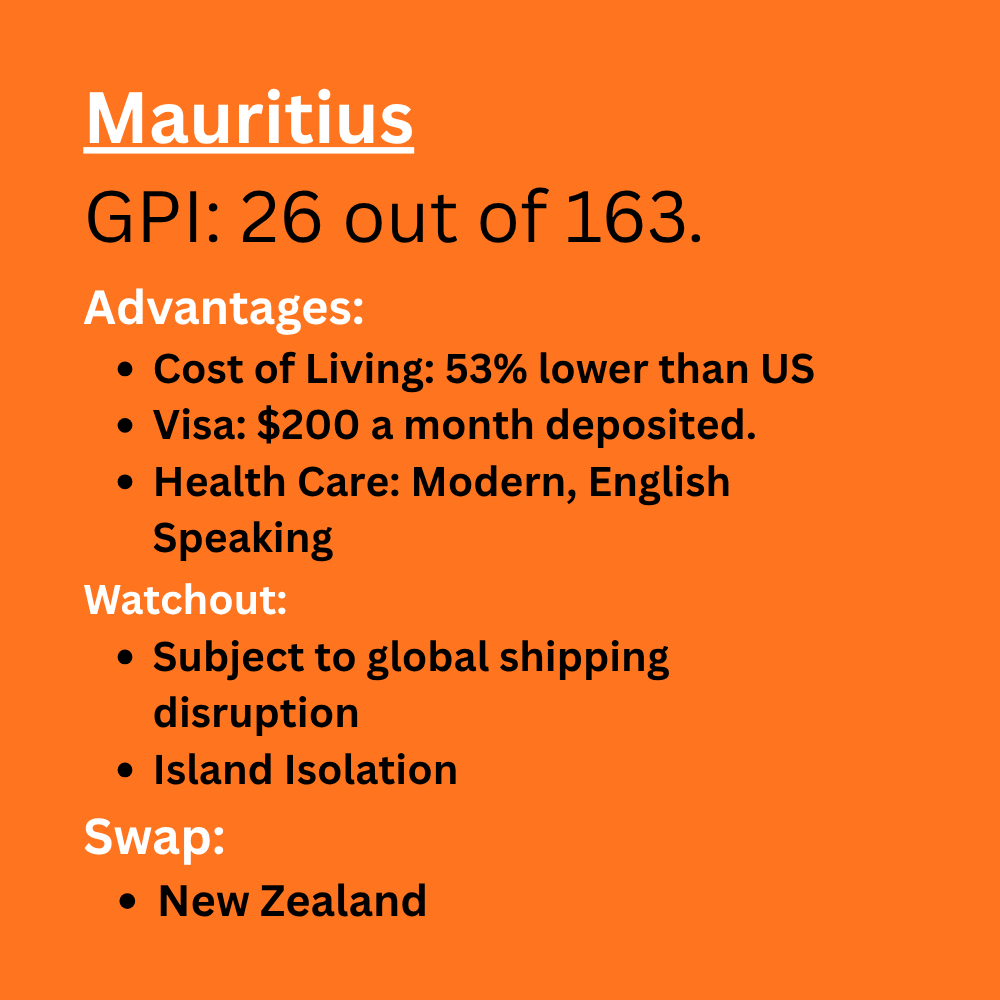
Cost of living runs roughly 53% lower than the U.S. average including rent. English is an official language. The private healthcare system is modern and there’s no language barrier in medical or legal settings. The Retirement Permit requires a $2,000 monthly transfer into a Mauritian bank account, a minimum age of 50, and as of 2025, at least 180 days per year in the country. That residency requirement is being enforced. This is a real relocation commitment, not a part-time arrangement.
We want to be straight about two things. First, Mauritius imports a significant share of its food and energy, which creates a supply chain dependency that matters if long-term global stability is part of how you’re thinking about this decision. Second, and this is something Mike has been honest about in the episode: island living has a specific psychological profile. Small geography, finite variety, a pace that some people find genuinely restorative and others find gradually suffocating after the first year or two. That’s a real conversation worth having with yourself before you fall in love with the data.
If the peaceful, remote profile appeals but the geographic isolation doesn’t, New Zealand ranks 3rd in the world on the peace index. English-speaking, politically stable, geographically insulated. Getting a retirement visa there as an American is not straightforward, but if you qualify, it belongs on your list.
The One With the Best Data and the Most Fine Print
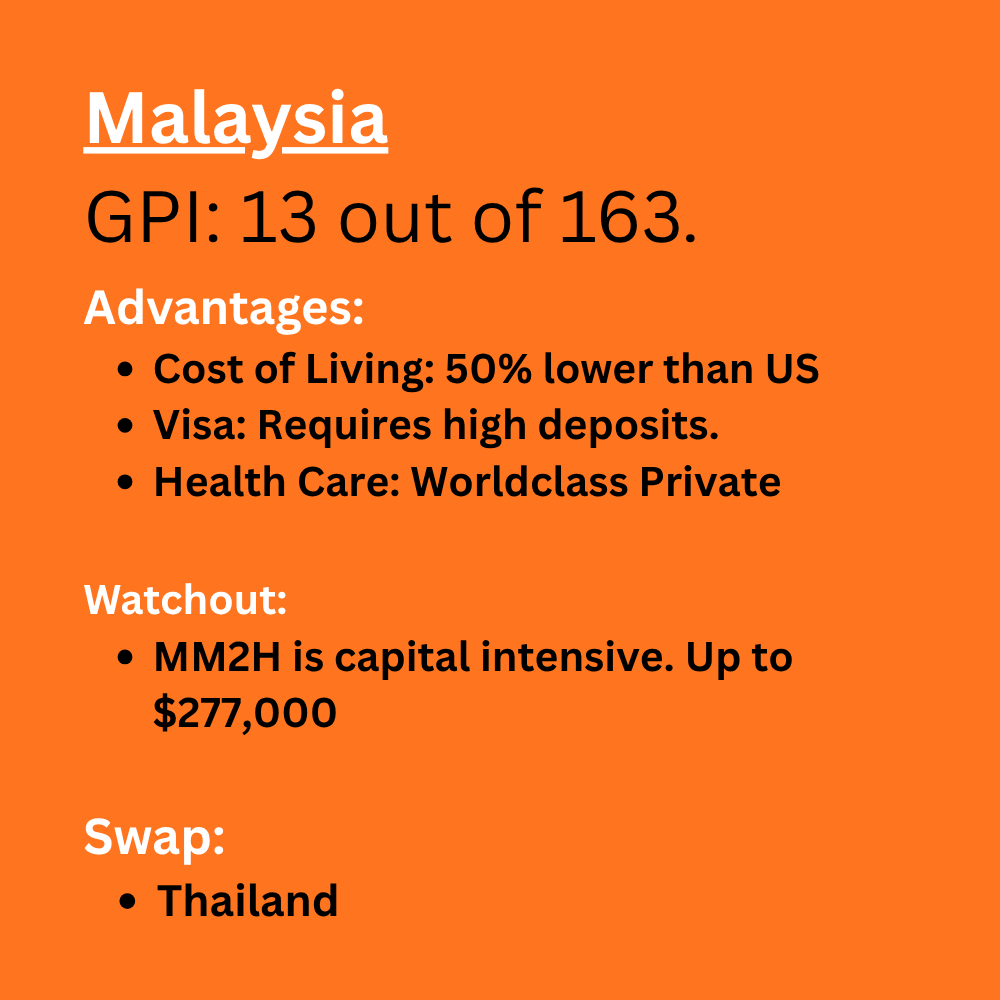
Malaysia — GPI Rank: 13th
Top 15 in the entire world. Cost of living roughly 50% lower than the U.S. average. Rent running about 76% lower. A one-bedroom in central Kuala Lumpur runs around $350 to $400 per month. World-class private healthcare at a fraction of what Americans pay. English widely spoken.
The long-stay program is called MM2H, Malaysia My Second Home, and here is where we’re going to be more thorough than most content on this topic, because the comment sections on the videos that skim the details are full of people who felt misled.
MM2H is not an income-based visa. The Silver tier, the entry-level option, requires a fixed deposit of approximately $150,000 USD in a Malaysian bank plus a property purchase of at least 600,000 Malaysian Ringgit, roughly $127,000 USD today. That’s a combined commitment of around $277,000 before living expenses, plus a 90-day annual stay requirement and mandatory applications through a licensed agent.
There is a lower-barrier option worth knowing before you count Malaysia out. The SEZ category, built around the Forest City development in Johor near Singapore, requires a deposit of $65,000, or $32,000 if you’re over 50. It’s location-restricted to that specific development zone, so it’s not flexible, but it’s a real entry point if the standard MM2H capital requirement puts it out of reach right now.
This program has also revised its rules multiple times. Treat everything here as a starting point and verify current requirements before making any decisions.
Thailand remains our personal parallel to consider if Southeast Asia appeals but MM2H capital requirements are out of reach. It ranks 86th on the peace index, still well above the U.S., with comparable private healthcare quality. The retirement visa requires 800,000 Thai Baht in a Thai bank account, roughly $22,000, and a minimum age of 50. If we’re being transparent, Thailand is the destination that keeps coming back up in our own research. It’s not confirmed, but it hasn’t left the list.
The One That Lives Up to the Hype, With Caveats
Portugal — GPI Rank: 7th
We’re ranked 128th. Portugal is 7th.
Portugal has become the consensus answer in early retirement circles, and popularity has done what it always does: Lisbon and Porto have gotten more expensive, the tax program that once made Portugal unusually attractive for foreign retirees has ended for new applicants, and the destination now requires sharper research than it would have three years ago. None of that makes it the wrong answer. It means the version of Portugal that works for you is more location-specific than it used to be.
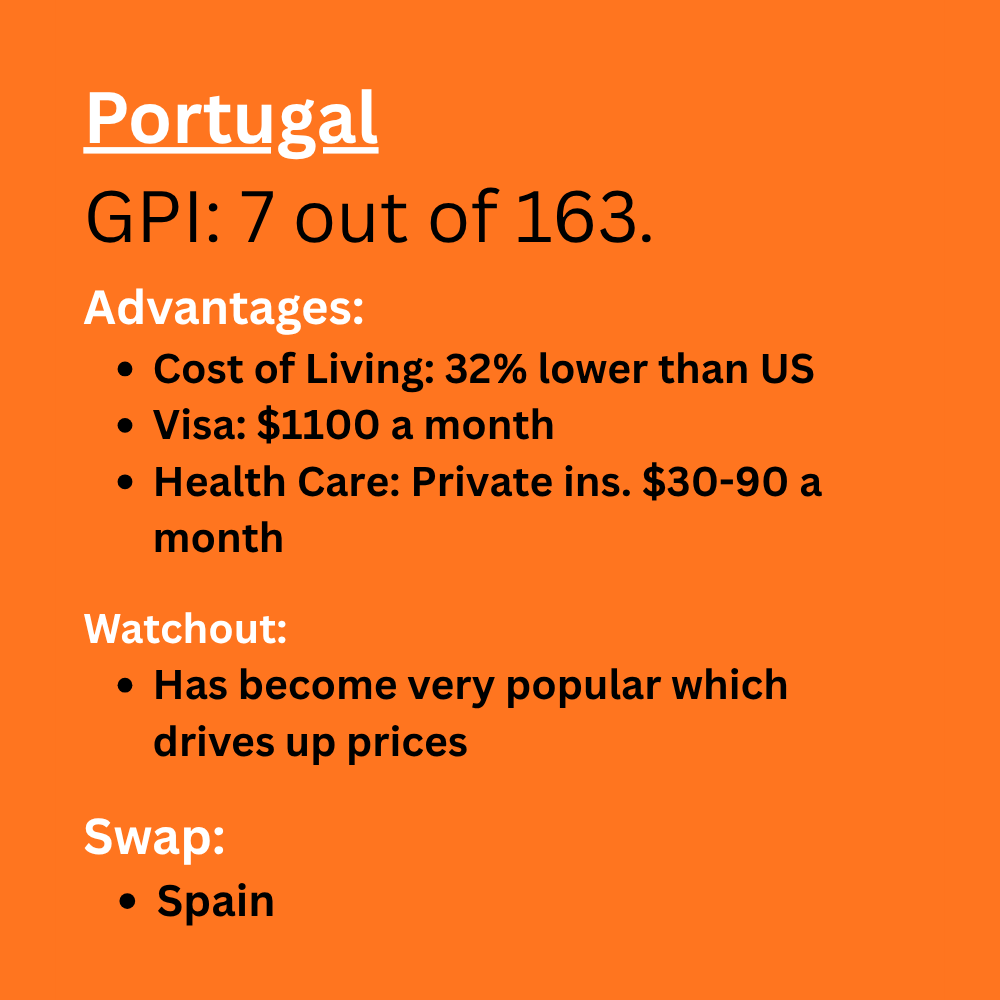
The D7 Passive Income Visa is still one of the cleanest retirement pathways we’ve found anywhere. The income threshold sits at €920 per month for 2026, roughly $1,100, covering the main applicant. A spouse adds 50% to the requirement. No investment required. Social Security, pension, dividends, and rental income all qualify. After five years of legal residency you can apply for permanent residency. After that, Portuguese citizenship, an EU passport, and visa-free access to the entire Schengen Area.
Healthcare for legal residents is low-cost. GP visits carry co-pays of roughly €2 to €5. Private health insurance runs around $30 to $90 per month depending on coverage. Compare that to the average American paying around $600 per month for basic marketplace insurance without subsidies.
The Alentejo region, smaller cities, and the interior still offer genuinely affordable living. The 32% below U.S. average figure is a country average. Lisbon isn’t that. Where inside Portugal you settle now matters more than the country-level decision.
Spain is the adjacent option we’d point toward for anyone who finds Portugal too picked over. It ranks 25th on the peace index, similar climate, comparable culture, its own long-stay visa options for passive income earners. We spent time in the Canary Islands and came away genuinely impressed. It’s not a consolation prize.
What We’d Actually Tell You to Do With This
Don’t try to evaluate all five at once. That’s how people spend two years in the research phase and never book the trip.
Pick the one or two that fit your actual life, your language comfort level, your capital picture, and what an ordinary weekday looks like in that place. Then go see it. Nothing in a spreadsheet or a YouTube video replaces being there.
If you’re still working out which direction to even point yourself, the Dream Destination Worksheet was built for exactly this stage. It’s a 15-question diagnostic that helps you move past “I love that place” and surface the real deal breakers that lead to long-term happiness in a new home. [Download it here →]
And if the bigger question is when you can actually leave, the Bridge Fund Calculator maps the gap between where you are today and your real Freedom Date so you’re working toward a target instead of a vague someday. [Get the calculator here →]
👉 Watch the full episode on YouTube for the complete breakdown, including the visa details and our unfiltered take on each destination.
Links Mentioned in This Article
Global Peace Index 2025: visionofhumanity.org
Cost of Living Data: Numbeo.com
Dream Destination Worksheet: [Link to GenXit Guide here]
Bridge Fund Calculator: [Link to GenXit Guide here]
Who We Are
Mike & MJ are the voices behind The GenXit Project, a resource for Gen X professionals exploring early retirement, financial independence, and life abroad. We cover international relocation, expat finance, and the real logistics of leaving it all behind (in the best way). Follow our journey on YouTube and the website as we turn “what if” into “what’s next.”