You’ve been doing the research. You know Thailand’s cost of living is a fraction of what you’re paying now in Chicago or Portland or wherever home is. You’ve read about the food, the weather, the healthcare system, the pace of life. And at some point, the visa question hit you like a brick.

Which one do you need? How much money gets locked up? Do you need a lawyer? What happens if you leave the country for a week?
We’ve been asking the same questions. We’re two global nomads in our mid-50s, planning a real exit on a real timeline, and Thailand keeps landing near the top of our list for reasons that go well beyond the headlines. So we did the research, sat with the numbers, and broke down the four main long-stay visa options available to anyone 50 and over.
Here’s what we found, what we’re planning to use, and why.
▶ Watch the full episode on YouTube for our complete visa breakdown, including the specific bank rule that catches most people off guard: [Link to YouTube video]
Why Thailand Keeps Coming Up
Portugal gets the lifestyle press. Mexico has great food and close proximity to the US. But when you actually run the cost-of-living numbers, Thailand keeps landing near the top of serious relocation lists. And it’s not hard to understand why.

We’re not talking about a modest discount on your current lifestyle. We’re talking about a genuine upgrade for significantly less money. World-class hospitals. Infrastructure that works. A food culture that will ruin you for anywhere else. And a climate that makes the 9-month Chicago winter feel like a choice you actively made against yourself.
When I walked Bangkok for the first time, I expected overwhelming. What I found was a city that has its own rhythm. The markets run all night. Ancient temples sit in the middle of modern neighborhoods like they’ve always been there, because they have. The scale is real, the traffic is real, but so is the energy.
Chiang Mai is a different experience entirely. The Old City sits inside a moat, temples around every turn, street food that earns its reputation. Drive 20 minutes north and you’re standing at Doi Suthep looking out over the entire valley. Sunday nights, the Walking Street fills up with vendors and locals and long-term residents moving at a pace that Bangkok never really offers. It’s human-scaled. And that’s exactly what a lot of people in our situation are looking for.
The point is: Thailand isn’t a vibe. It’s a practical choice backed by real numbers. And if you’re serious about living there long term, you need to understand how to stay legally.
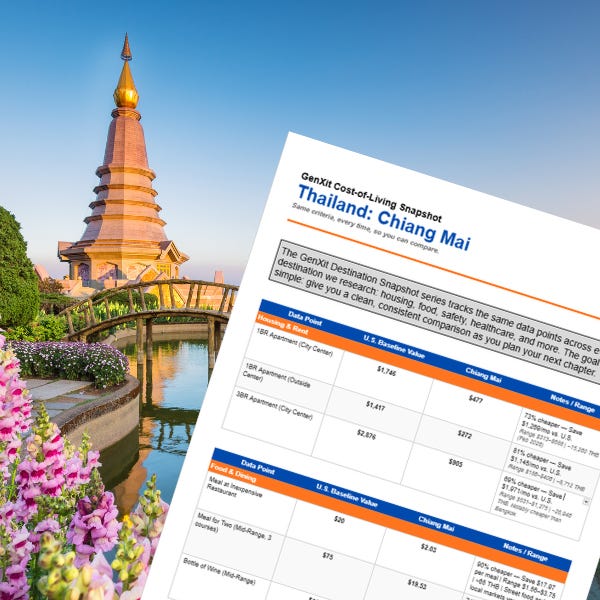
📊 We pulled the real numbers on Thailand — housing, food, utilities, healthcare, and safety, all benchmarked against U.S. averages. Download our free Thailand Destination Snapshots (National Average, Bangkok, and Chiang Mai) at TheGenXitProject.com: [Link to Thailand Destination Snapshots]
The Four Visa Options: A Plain-Language Overview
When you start researching long-term stays in Thailand, four names keep appearing. Here’s the honest overview before we go deeper.
Non-Immigrant O-A Retirement Visa (Non-O)
This is the standard. The majority of long-term retirees in Thailand use this one. You need to be at least 50, you can’t work while on it, and it renews annually. There are financial requirements, a bank seasoning rule, and a few procedural steps that matter. But it’s stable, it’s proven, and it’s the most accessible entry point for most Gen X early retirees.
Thailand Privilege Visa
This is the premium pay-upfront option. You’re buying a membership program, not applying for a visa in the traditional sense. No annual financial reporting, VIP airport treatment, concierge services. The fee ranges from roughly $20,000 USD for a five-year entry-level package up to a 20-year option at the top tier. That money doesn’t come back to you. It’s a convenience purchase, not a deposit.
Long-Term Resident Visa (LTR)
A 10-year renewable residency processed through Thailand’s Board of Investment. The passive income threshold for the Wealthy Pensioner category is $80,000 USD per year. There’s a path in at $40,000 per year with a $250,000 qualifying Thai investment. The income bar is high, and intentionally so. This is built for a specific tier of retiree.
Destination Thailand Visa (DTV)
This one launched in 2024 and it’s worth knowing if you’re not yet 50 or still generating remote income. Five-year multiple-entry visa, 180 days per entry, roughly $15,000 USD in savings required, plus proof of remote work from a non-Thai employer. It’s not a retirement visa. But for global nomads still in the wind-down phase of a US career, it’s a legitimate bridge.
Note: Exchange rates move. All USD figures in this article are approximations based on rates at time of writing. Always check the current Thai Baht rate when you’re actually doing the math on your own situation.
The Non-O Retirement Visa: What You Actually Need to Know
We’re spending the most time here because this is the one we’re personally planning around, and we think it fits the broadest range of people reading this.
The Basic Qualifications
You need to be at least 50. You cannot work in Thailand on this visa. Those two things are non-negotiable.
On the financial side, you have a few options:
• 800,000 Thai Baht in a Thai bank account (roughly $25,000 USD at current rates)
• 65,000 Thai Baht per month in pension or passive income (approximately $2,000 USD monthly)
• A combination of savings and income that together satisfy the threshold
The Seasoning Rule (This Is the Part Most People Miss)
This is what catches people off guard, and it’s the most important procedural detail in the entire Non-O process.
That 800,000 Baht needs to sit in your Thai bank account for a full three months before you apply for your annual extension. After your extension is approved, it stays at 800,000 Baht for three more months. After that window, it can drop, but it can never go below 400,000 Baht. Not by one Baht. Immigration checks. Some provinces require three months of seasoning before application instead of two, so verify the rules in your specific province.
The most important thing to understand: that money is still yours. It’s not a fee, it’s not a program buy-in, it’s not gone. If you leave Thailand permanently, you get it back. It’s proof of funds sitting in a local account, nothing more.
MJ’s first reaction when we hit this part of the research was: ‘So it just... sits there?’ Yes. And once you reframe it that way, it stops feeling like a barrier.
💡 Building toward that 800,000 Baht figure? Our Bridge Fund Calculator helps you map the exact savings timeline from your current income to your exit date. Get it free at TheGenXitProject.com [Link to Bridge Fund Calculator here]
How the Process Actually Works
You don’t just arrive in Thailand and apply. The process starts before you leave home. You get an initial 90-day Non-O visa from a Thai embassy or consulate in the US. That gets you into the country legally. Once you’re there, you open a Thai bank account and deposit your 800,000 Baht. You wait for the seasoning period. Then you go to your local immigration office and apply for your one-year retirement extension.
After that, it’s an annual renewal. Once you know the rhythm, it’s manageable.
Three Things That Consistently Trip People Up
• Bank documentation varies. Different Thai banks handle the seasoning period documentation slightly differently. Go to a bank where someone speaks English and can walk you through exactly what they need. Don’t assume they all work the same way.
• Re-entry permits are not optional. If you leave Thailand while your visa extension is active and you don’t have a re-entry permit in hand before you cross the border, your extension is cancelled the moment you leave. You’d start over. People take a quick trip to Vietnam or Cambodia without realizing this. Get the permit every single time.
• Insurance rules are evolving. There’s no mandatory health insurance requirement for Non-O renewals in most provinces as of this writing, but that has been changing. We recommend solid coverage regardless, not for the visa, but because it makes practical sense when you’re living abroad long term.
The Privilege Visa and LTR: Are They Worth It?
We said we’d cover all the options honestly, so here’s our genuine read on both.
The Thailand Privilege Visa makes sense for a specific type of person: someone who travels frequently, hates annual bureaucracy, and has the upfront cash to spend on convenience. The fast-track immigration lane and concierge assistance for government paperwork are real benefits. If you’re moving to Thailand and want to minimize the administrative overhead of staying legal, it’s a legitimate option. Just understand that the membership fee is gone the moment you pay it. You’re buying ease, not equity.
The LTR is a different conversation entirely. The $80,000 USD annual passive income requirement puts it out of reach for most Gen X early retirees who are still building toward financial independence. If you’re drawing that level of passive income from pensions, dividends, or rental properties, the tax advantages for overseas income are meaningful. But it’s built for a tier above where most of our audience is right now.
What If You’re Not 50 Yet?
A significant portion of the people we hear from are 46, 47, 48 years old. They’re doing the math, they’re planning the exit, and the Non-O retirement visa isn’t available to them for a few more years.
The Destination Thailand Visa is worth understanding for exactly this group. It was launched in 2024 partly as a formal alternative to the informal ‘visa run’ pattern that had become increasingly scrutinized by Thai immigration. More than two border runs a year can now trigger examination from immigration officials. The DTV gives you a legal, five-year multiple-entry option while you’re still working remotely or wrapping up a career.
The proof-of-remote-work requirement is real. A LinkedIn profile isn’t enough. You need documentation showing active income from a non-Thai employer. But for global nomads still in that transitional window, it’s a legitimate way to spend serious time in Thailand while you wait for the Non-O to open up.
How We’re Thinking About Our Own Exit
Here’s where we actually land after doing this research.
We’re two years out from making a move. The Non-O makes sense for us because we’ll be well past the 50-year threshold, the 800,000 Baht deposit is manageable without it feeling like a cost we can’t recover, and the annual renewal process is a checklist, not a burden. The Privilege Visa is appealing on paper, but we’re not willing to write a $20,000 check for convenience when the Non-O gives us the same legal standing and we keep our money.

The LTR isn’t our path at this stage. The income threshold is built for a different financial situation.
What the Non-O gives us that nothing else does is stability. Legal residency. The ability to open a bank account, sign a lease, access the healthcare system, and build an actual life in Thailand year over year without a massive upfront fee and without a high income bar to clear. That’s the foundation we’re planning on.
The Short Version Before You Go
Here’s the summary for anyone scanning:
• Non-O Retirement Visa: The most accessible path for retirees 50+. Annual renewal, financial requirements, bank seasoning rule. Money stays yours.
• Thailand Privilege Visa: Premium upfront membership. Convenience over process. Fee is gone once paid.
• LTR Visa: High passive income threshold. Strong benefits for those who qualify.
• Destination Thailand Visa: For under-50 remote workers building toward their exit. Legal long-stay option while you wait for the Non-O to become available.
The visa process isn’t the obstacle it looks like from the outside. It’s a checklist. You’ve navigated a thirty-year career in a system that was never designed to let you leave early. Figuring out a bank seasoning window is not the hard part.
📋 Not sure Thailand is the right fit for your situation? Our free Dream Destination Worksheet walks you through the 15 questions that separate a vacation fantasy from a real relocation match. Get it at TheGenXitProject.com [Link to Dream Destination Worksheet here]
Links Mentioned in This Article
Watch the Full Episode: Thailand Visa Breakdown on YouTube
Free Resource: Bridge Fund Calculator — Map your savings timeline to your exit date
Free Resource: Dream Destination Worksheet — Score and compare your top relocation candidates
Cost of Living Snapshots -
Who We Are
Mike & MJ are the voices behind The GenXit Project, a resource for Gen X professionals exploring early retirement, financial independence, and life abroad. We cover international relocation, expat finance, and the real logistics of leaving it all behind (in the best way). Follow our journey on YouTube and the website as we turn “what if” into “what’s next.”